
Índice
ToggleHow AI Is Transforming 3D Rendering and Architectural Visualization
Artificial Intelligence is revolutionizing the way design and architecture studios produce photorealistic visuals. Today, integrating AI into 3D rendering and visualization workflows allows the creation of product and building images and animations faster, with greater precision and creativity than ever before.
At Vimap Studio, we combine traditional 3D techniques with the latest AI tools to generate visual assets that communicate ideas and projects in a powerful way.
Ideation and Conceptual Design with AI
Generating a compelling concept is the first step in any visualization project. AI tools make this phase easier by allowing the creation of moodboards and concept images from text prompts or quick sketches.
Platforms like Midjourney, Stable Diffusion, Krea AI… help visualize different styles, atmospheres, and perspectives in minutes instead of days. This allows exploring multiple ideas before committing time to full 3D modeling and aligning the vision with clients from early stages.
AI-Assisted 3D Modeling
Once the concept is defined, the next challenge is creating accurate 3D models. Tools like Kaedim 3D and Meshy AI can transform sketches or reference images into base 3D meshes, covering much of the initial modeling.
In architectural visualization, AI can generate secondary elements or context, such as nearby buildings or furniture, which we then refine manually. It also allows suggesting or creating specific assets when they are not found in libraries, speeding up production without sacrificing quality.
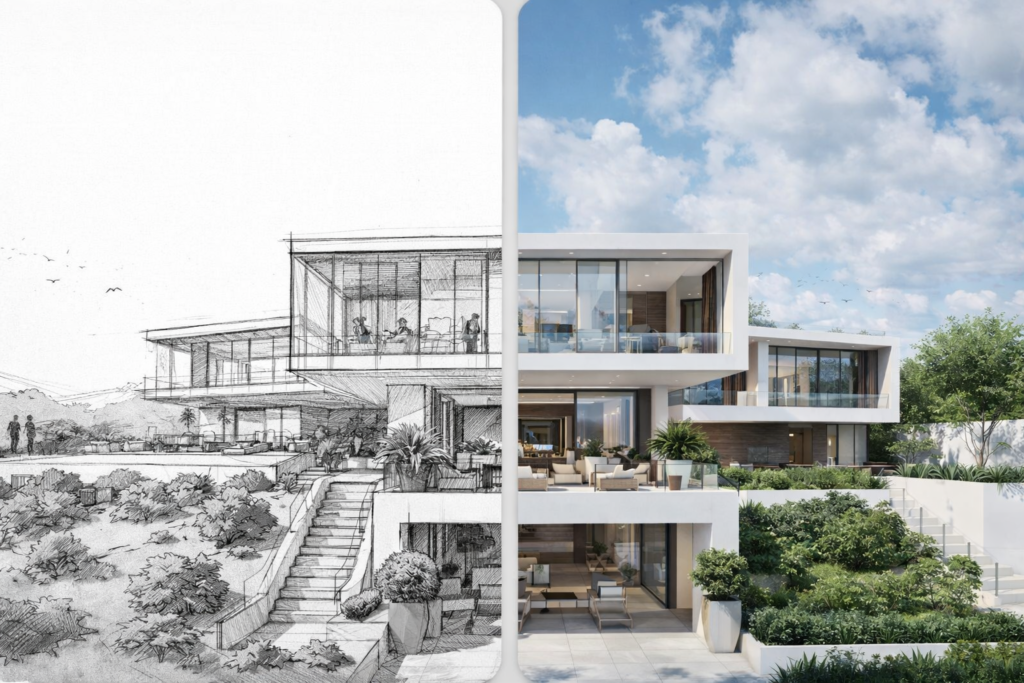
AI Rendering and Visualization
The most transformative impact of Artificial Intelligence occurs in the rendering process itself: converting 3D models into photorealistic images. Today, rendering engines incorporate AI-based systems that speed up production times and improve final quality.
One of the most notable innovations is AI Denoising, which cleans noise from a partially rendered image in seconds, drastically reducing computation time without compromising visual realism.
- AI denoising: cleaner images in less time.
- AI upscaling: increased resolution and detail without re-rendering.
- Creative AI rendering: applying styles, materials, and atmospheres via text prompts.
Additionally, tools like Arko AI, LookX, Visoid, or PromeAI allow the application of complete visual styles to base models, enabling quick comparisons between different finishes, lighting, or environments without redoing the entire technical process.
This hybrid approach reduces GPU usage, accelerates iterations, and frees up more time for creative refinement and artistic control.
AI Post-Production and Editing
Once the base render is generated, AI becomes a key ally in the post-production phase. Current tools allow modifying, expanding, and optimizing images at a speed that was unthinkable just a few years ago.
Features like generative editing enable changing backgrounds, adding vegetation, people, or architectural elements in seconds, while maintaining perspective and lighting consistency.
- Generative Fill: replacing or expanding elements with intelligent context.
- Assisted Relighting: adjusting lighting without re-rendering.
- Smart Recoloring: variations of materials or finishes in seconds.
Additionally, tools like Magnific.ai allow advanced upscaling, improving textures, reducing noise, and optimizing fine details without redoing the full render, which saves significant time and resources.
This combination of traditional 3D rendering and AI-assisted enhancement optimizes final quality and expands creative possibilities without compromising technical accuracy.
Modern AI Tools for Architectural Visualization
In addition to traditional methods, studios are adopting new AI tools that enhance creativity and efficiency:
Concept and Moodboard Generation
Tools like Krea AI, Runway, Adobe Firefly, Veo, or Kling allow generating conceptual images and moodboards from text prompts or sketches. This accelerates the ideation phase and enables exploring different styles and atmospheres before producing full renders.
AI in Video and Animation
These platforms also transform static renders into animated clips or virtual walkthroughs, facilitating:
- Project presentations to clients.
- Quick virtual walkthroughs of interiors and exteriors.
- Visualization of changes in lighting, materials, or furniture without redoing the full render.
Render Enhancement and Optimization
Tools like Magnific.ai optimize existing images and videos by applying upscaling, noise reduction, lighting adjustment, and detail enhancement. While they don’t generate renders from scratch, they allow presenting high-resolution photorealistic visuals without re-rendering, saving time and resources.
Key Benefits of Integrating AI in Architectural Visualization:
- Rapid generation of ideas and visual prototypes.
- Explore more variants and styles before finalizing a design.
- Production of animated clips or virtual walkthroughs from static renders.
- Improved image and video quality and resolution for presentations or marketing.
- Complementing human creativity, enhancing efficiency without sacrificing accuracy.
Workflow Optimization
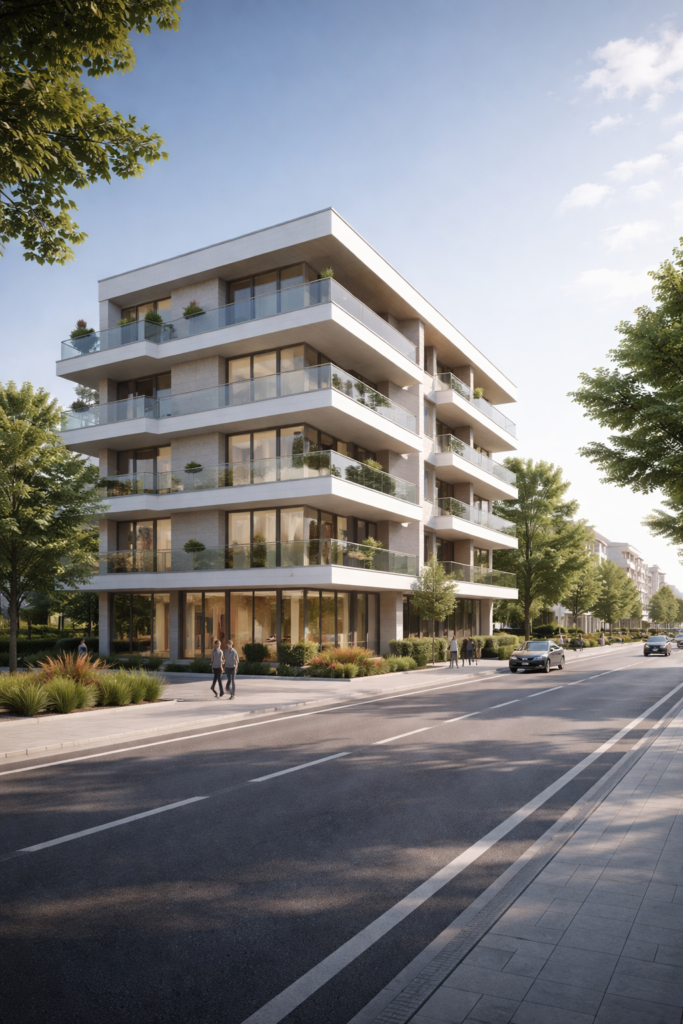
AI not only improves individual tasks but also optimizes the entire pipeline: ideation, modeling, rendering, and post-production. This enables:
- Faster execution and more iterations per project.
- Consistency of style and quality across render series.
- Reduction of errors and unnecessary revisions.
- More time for creative refinement and visual detail.
In short, AI acts as a strategic ally: it accelerates processes, enhances creativity, and keeps human artistic control intact at all times.
Why Partner with an AI-Enabled 3D Studio?
Working with a studio that integrates AI into its workflow offers concrete advantages:
- Faster delivery: high-quality results in less time.
- Cost efficiency: more outputs without increasing the budget.
- Unlimited iterations: the ability to explore variants and styles.
- Aesthetic innovation: the combination of AI and human creativity produces unique ideas and compositions.
- Reliability and consistency: quality control and uniformity across large volumes of renders.
Overall, AI enhances studio efficiency and creativity, taking architectural and product visualization to a new level.

Conclusion
The integration of Artificial Intelligence in architectural visualization and 3D rendering does not replace human talent, but represents a natural evolution of the creative and technical process. By combining advanced generation, automation, and optimization tools with professional expertise, it is possible to achieve higher levels of efficiency, quality, and iteration capacity.
In an environment with increasingly tight deadlines and higher visual competition, adopting a hybrid approach AI + artistic judgment becomes a strategic advantage. Technology accelerates processes; human vision defines the outcome.
Vimap Studio embodies precisely this combination: a team of professionals who understand architecture, master 3D technology, and strategically apply Artificial Intelligence to transform ideas into images that inspire, sell, and communicate clearly.
If you are developing a project and need high-level architectural visualization or 3D rendering, you can request a free quote through our contact page. We will be happy to review your project and propose the best visual solution.